Skip to content
Three employees having a coffee break at a Kemira office.
2/20/2026

Frequently asked questions

What is Kemira’s vision and strategy?

Kemira is a global leader in sustainable chemical solutions for water-intensive industries – with roots over a hundred years ago. Our customers include large companies in the pulp and paper sector, as well as municipal and industrial water treatment companies. With our solutions, our customers can advance circularity and responsible resource stewardship in their value chains.

Sustainability transformation is driving the growth, and our aim is to double the revenue in water in the long run. This is supported by the tightening regulation globally. In addition, by the end of 2030 over 500 million of our revenue is targeted to come from renewable solutions.

Our long-term financial goals are:

  • Average annual organic growth over 4%
  • Operative EBITDA margin of 18–21%
  • Operative ROCE over 16%

Read more about Kemira’s strategy.

What drives growth in Kemira’s markets?

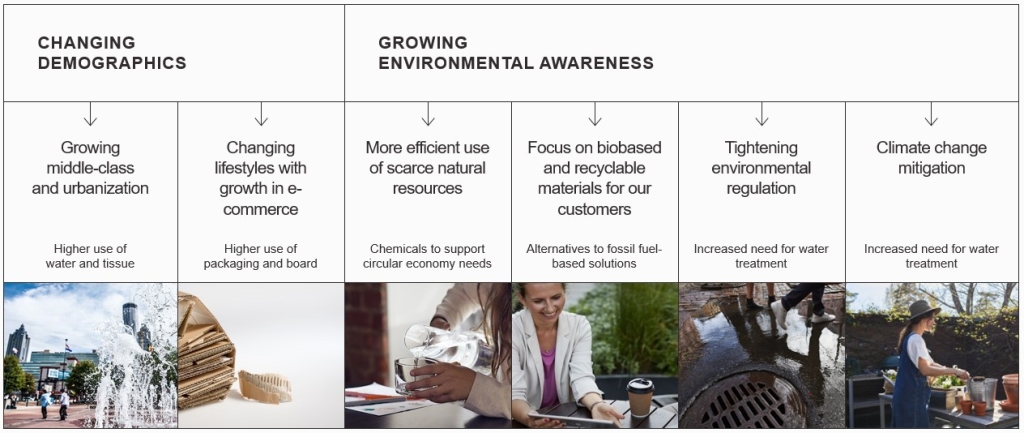
The two most important global megatrends driving growth of Kemira’s end markets are changing demographics and growing environmental awareness, which is further resulting in tightening regulation.

Changing demographics

A growing middle-class population, particularly in Asia-Pacific, is expected to result in higher use of water, which will ultimately drive the demand for water treatment chemicals. Changing lifestyles and growth in e-commerce, partly driven by higher income per capita, will lead to higher need for packaging solutions globally. This will further boost the demand for pulp and paper chemicals; Kemira’s core expertise.

Growing environmental awareness

The overall sustainability trend, including more efficient use of natural resources and higher need for recyclable products  is expected to be beneficial for Kemira’s end-markets. Kemira’s solutions enable its customers to use resources, water included, more efficiently. One particular trend, the replacement of plastic packaging, is expected to drive growth of fiber-based packaging solutions. This in turn is expected to increase the demand for pulp and paper chemicals. In addition, the tightening regulation supports Kemira’s ambition to double its water treatment business.

Global megatrends largely favor Kemira – sustainability becoming a key driver for the long term
In which businesses does Kemira operate?

Kemira is a global leader in sustainable chemical solutions for water-intensive industries. We provide the best suited products and expertise to improve our customers’ product quality, process and resource efficiency. We have three business units: Water Solution, Packaging & Hygiene Solutions and Fiber Essentials

Water Solutions

  • Provides water treatment solutions for both municipal and industrial water treatment facilities
  • ~45% of total sales
  • Strong focus on growth and cash flow

Packaging & Hygiene Solutions

  • Focuses on the growing renewable solutions market, particularly packaging
  • ~35% of total sales
  • Attractive, potential new growth markets: molded fibers, textile fibers, renewable chemistry solutions & digital services

Fiber Essentials

  • Provides critical chemicals for the pulp and bleaching market
  • ~20% of total sales
  • Sodium Chlorate the largest business; market growing particularly in South America

Where does Kemira want to grow?

Water and renewable solutions are at the heart of the new Kemira. Water is expected to be the key contributor for revenue growth going forward. Kemira announced in September 2024 that its new long-term ambition is to double the revenue in water. This includes both organic and inorganic growth possibilities.

Firstly, possible acquisitions could be related to market consolidation in Kemira’s more mature markets in EMEA and North America, where Kemira already has a strong presence. Secondly, new technologies and competencies could be also be possible as these would complement Kemira’s current product offering of coagulants and polymers to its water treatment customers. Thirdly, Kemira could also look at possible acquisition targets in the APAC market to strengthen its presence there. Currently Kemira has only a small presence in the growing APAC water treatment market.

Read more about the growth drivers here.

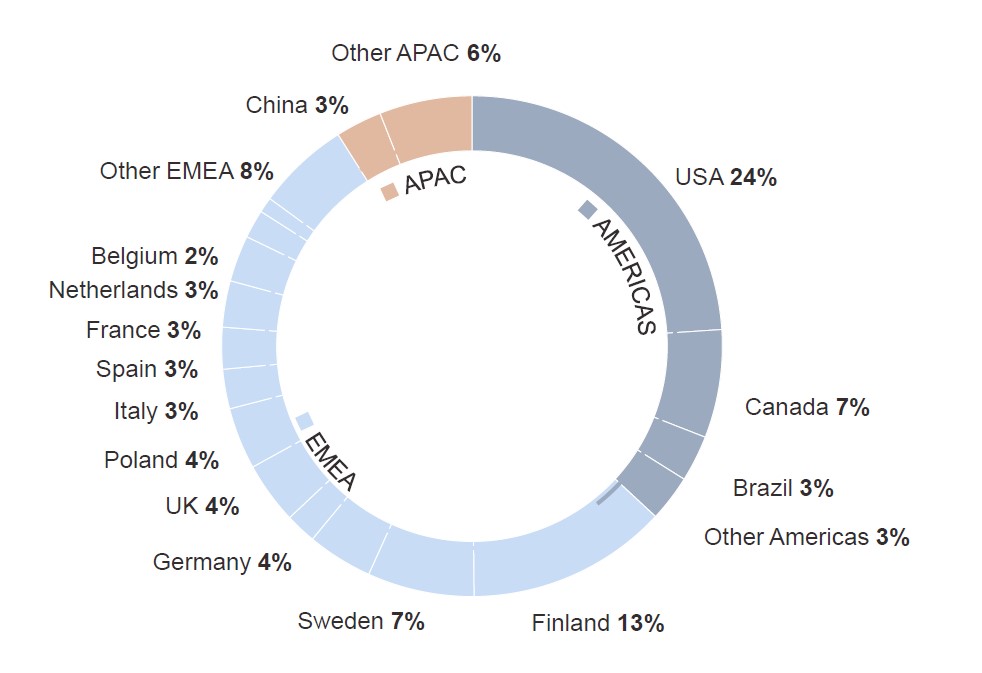
Where does Kemira operate and what are the most important countries by sales?

The US is the largest country in terms of sales and it accounted for 24% of revenue in 2024. Finland, the second largest country by sales, accounted for 13%.

Revenue split by country in 2025
Is Kemira’s business seasonal or cyclical?

Overall, Kemira has a very resilient business model, which is not very prone to economic cycles. Kemira produces consumable chemicals that are used in customers’ processes, such as wastewater treatment or at pulp and paper mills.

 

Who are Kemira’s main competitors?

Water Solutions Polymers: e.g. SNF, Solvay, Ecolab, Solenis and coagulants: mainly local companies e.g.; Feralco, USalco, Chemtrade
Packaging & Hygiene Solutions Solenis, SNF, Ecolab, Buckman
Fiber Essentials Nouryon, Solvay, Erco, Chemtrade

Who are Kemira’s major shareholders?

Kemira’s largest shareholder is Oras Invest. See the monthly updated list of Kemira’s largest shareholders.

What is Kemira’s dividend policy?

Kemira updated its dividend policy in 2020. Kemira’s dividend policy aims at paying a competitive and over time increasing dividend.

How many shares does Kemira management own?

See the updated list of Kemira management’s shareholding.

When is the dividend paid?

The dividend payout date varies from year to year. Read more information on historical dividend.

Has Kemira had share buyback programs?

Yes. Read here more about the share buyback programs.

When was Tikkurila spun off from Kemira? What is Tikkurila’s acquisition price for taxation purposes?

Tikkurila was listed in 2010. Read more in the stock exchange release of March 11, 2010. The taxation value of Tikkurila’s price in Finnish taxation is 15,80 EUR (the weighted average share price of the first trading day, March 26, 2010).

What are Kemira’s financial targets?

Kemira has three long-term financial targets:

  • Average annual organic growth over 4%
  • Operative EBITDA margin of 18–21%
  • Operative ROCE over 16%

Read more about Kemira’s financial targets.

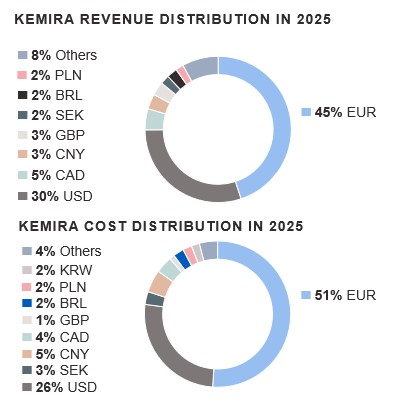
How do exchange rate fluctuations impact Kemira?

Main impact on Kemira comes via translation impact. Transaction risk is limited as revenues and costs are typically in the same currency as Kemira operates in most cases locally and has local production close to its customers. If there is any transaction risk, it is mostly hedged.

For modeling purposes, a 10% change in Kemira’s main foreign currencies would have approximately a EUR 15 million impact on operative EBITDA on an annualized basis.

Kemira’s reporting currency is the EUR. Please see below for the currency distribution by revenue and costs.

Is Kemira exposed to raw material fluctuations?

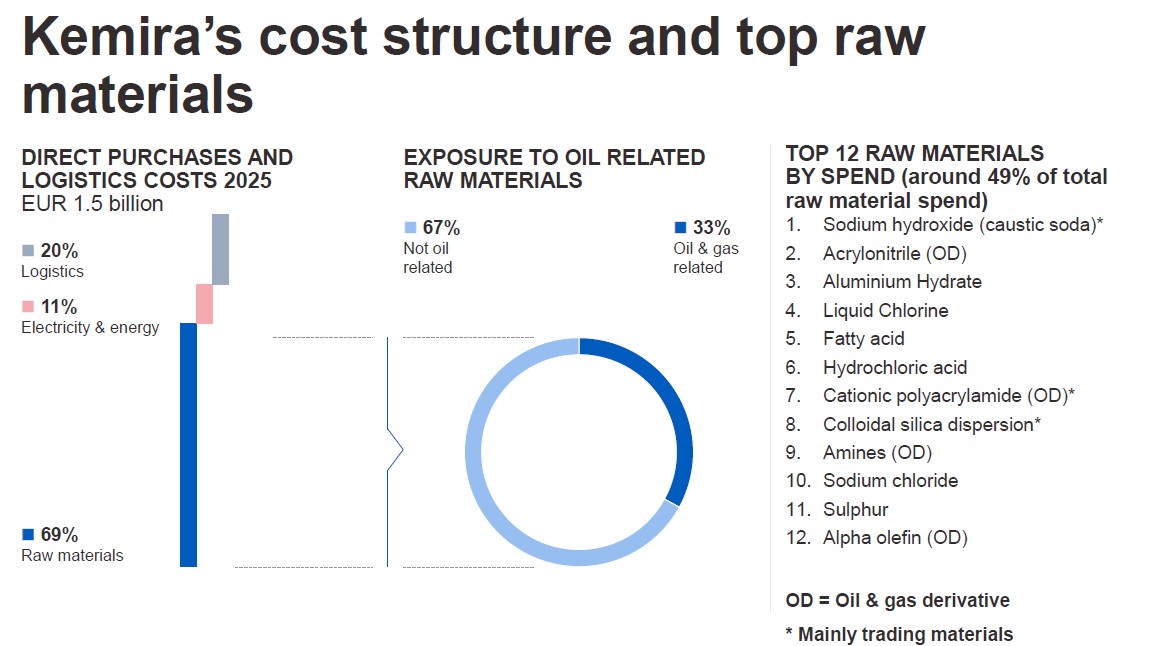
Kemira is a significant buyer of various raw materials due to the nature of its business. The annual raw material spend is around 1 BNEUR, which is split into oil & gas derivatives and non-oil related raw materials.

Please see below for a more detailed split of Kemira’s cost structure and top raw materials in 2025.

What is Kemira’s financing base?

Read more; Kemira’s debt information

How large a share of Kemira’s revenue is allocated to R&D?

In 2025, total research and development expenses were EUR 35.3 million, representing 1.3% of the Group’s revenue. Sustainable and renewable solutions are cornerstones of Kemira’s strategic priorities and, consequently, also the focus of the majority of Kemira’ innovation projects. In addition, over half of Kemira’s ongoing innovation projects are being worked in collaboration with external partners.

What are Kemira’s sustainability targets?

Kemira has identified five sustainability focus areas: safety, people, water, circularity and climate. You can read more here.

Which United Nation’s Sustainability Goals (SDGs) are most important for Kemira?

Kemira has identified the following SDGs to be of most material impact:
SDG6 Clean water and sanitation
SDG8  Decent work and economic growth
SDG12 Responsible consumption and production
SDG13 Climate action

How will sustainability drive Kemira’s business?

Kemira’s customers are increasingly focused on the environmental impacts of their operations. Following consumer pressure, there is increasing demand for biodegradable and recyclable products and also for products enable more sustainable processes.

Almost 60% of Kemira’s revenue comes from products that improve customers resource efficiency. One of Kemira’s objectives is also to increase its revenue from renewable solutions. The aim is to reach 500 MEUR in renewable solutions revenue by the end of 2030 from around  EUR 100 million in 2019.

Where can I read more about sustainability?

You can explore Kemira’s Sustainability Statement 2025 here, starting from the page 73.

More information can also be found at the Sustainability pages here.


Kemira is a leading provider of sustainable chemical solutions for water-intensive industries


We enable more sustainable processes and products for our customers


We aim for
long-term growth


We continue to drive profitability and operational excellence

How does Kemira ensure sustainability in its supply chain?

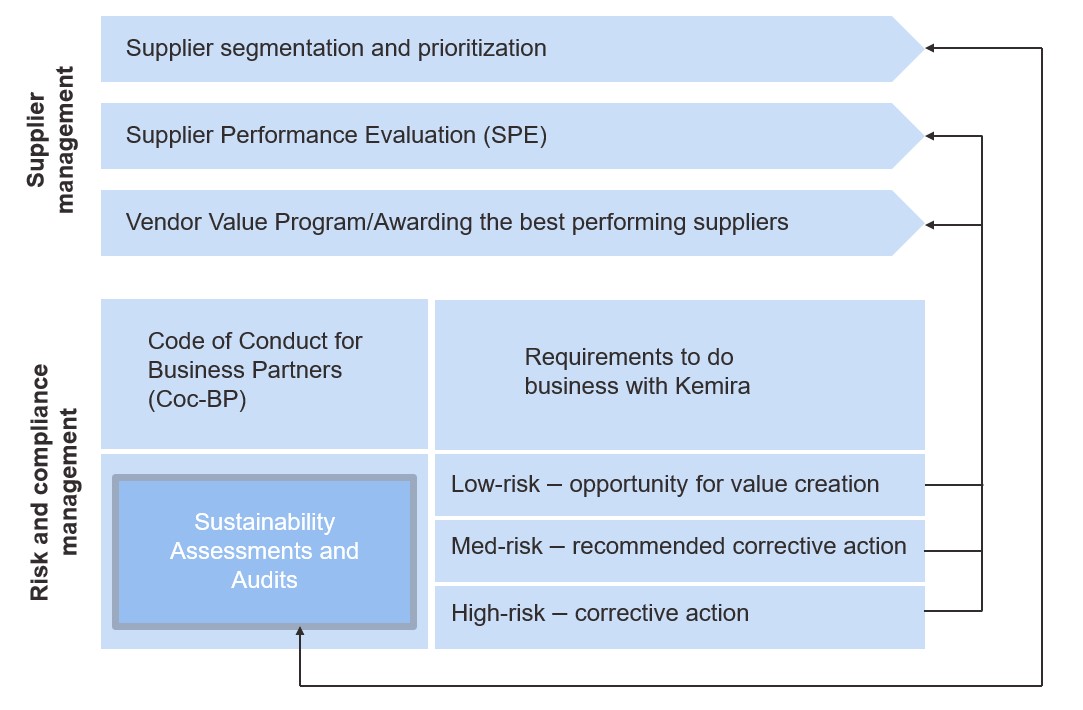
Kemira has thousands of suppliers and Kemira’s sourcing function is globally responsible for strategic spend management. Kemira’s suppliers are segmented into four categories: strategic, critical, volume and base suppliers. Kemira conducts supplier performance evaluations, and all suppliers are expected to adhere to Kemira’s Code of Conduct for Business Partners.

Supplier and supplier risk and compliance management

You can explore Kemira’s Sustainability Statement 2025 here, starting from the page 73.

Kemira has completed the divestment of its Oil & Gas related portfolio

Additional alternative key figures

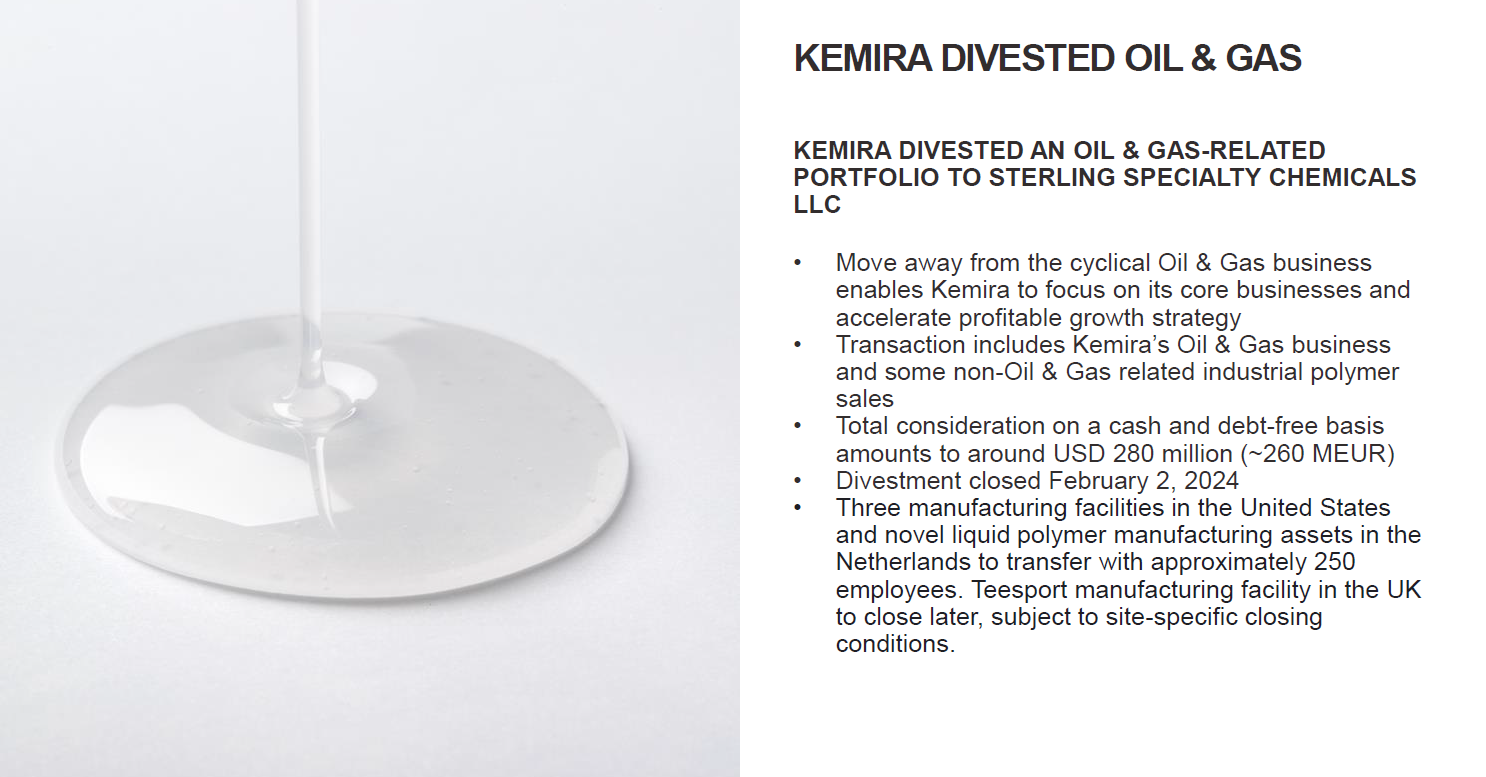
On February 2, 2024 Kemira completed the divestment of its Oil & Gas related portfolio to Sterling Specialty Chemicals LLC, a US subsidiary of Artek Group, a global industrial chemicals group based in India. The divestment was announced on December 4, 2023.

The transaction enables Kemira to focus on its core businesses and accelerate its profitable growth strategy by focusing on growing in water treatment, building a leading renewable solutions portfolio and creating a digital services business.

Details of the transaction

The total consideration on a cash and debt-free basis amounts to approximately USD 280 million, around EUR 260 million with today’s exchange rate, subject to ordinary closing adjustments. Kemira expects to record a loss of around EUR 97 million during Q4 2023. The loss will be booked as an item affecting comparability.

The revenue to be carved-out from Kemira was around EUR 430 million in 2022. This includes Oil & Gas revenue of EUR 373 million in 2022. The remaining carved-out revenue of around EUR 57 million consisted of non-Oil & Gas industrial polymer sales through indirect channels that are produced in manufacturing facilities within the scope of the transaction.

Approximately 250 employees will transfer to the buyer as part of the transaction, which includes Kemira’s manufacturing facilities in Mobile, Columbus and Aberdeen in the United States and the novel liquid polymer (NLP) manufacturing assets in Botlek, the Netherlands. The closing of the Teesport manufacturing facility in the United Kingdom is expected to happen later, subject to site-specific closing conditions.

Please see below the main points summarizing the divestments: 


Back to top